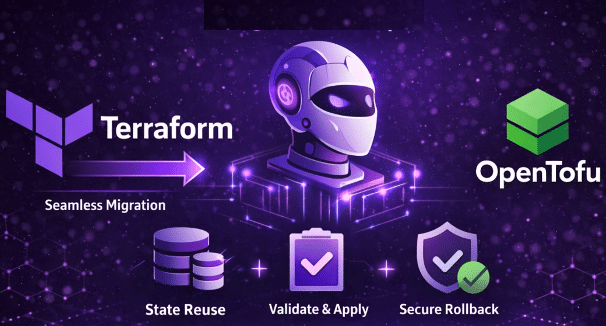
Terraform remains the most widely deployed multi-cloud provisioning tool. Teams write HCL that describes resources across AWS, Azure, Google Cloud, Kubernetes, Cloudflare, Datadog, and thousands of other providers. A graph of dependencies is built automatically so that a database is created before the application that needs its connection string, and a security group is ready before the instances that reference it. The workflow is familiar: write configuration, run plan to preview the diff, run apply to make the changes, and store the resulting state so future runs know what already exists.
Two developments have shaped the landscape since the mid-2020s. HashiCorp moved Terraform to a Business Source License and was later acquired by IBM. In response, the community created OpenTofu, a Linux Foundation project that preserves the HCL syntax and provider ecosystem while remaining fully open source under the MPL 2.0 license. For most existing codebases the migration path is straightforward; many organizations now treat OpenTofu as the default for new work or for environments that require unrestricted open-source licensing. Both tools share the same core strengths: a massive provider ecosystem, mature module patterns, and a clear separation between plan and apply that supports human review and automated gates.
State management is the most critical operational concern. The state file records the mapping between configuration and real-world resources. Local state is acceptable only for personal experiments. In any shared or production context the state must live in a remote backend (S3 with DynamoDB locking, Google Cloud Storage, Azure Blob, or a managed service) with encryption and access controls. State files frequently contain sensitive values; they should never be committed to Git and should be treated with the same care as secrets. Splitting state by environment and by logical boundary keeps plans fast and limits the blast radius of any single change.
Modules turn repeated patterns into reusable units. A well-designed networking module accepts CIDR ranges and availability-zone counts and returns subnet IDs and route-table references. Higher-level service modules compose those building blocks into complete application stacks. Versioning modules and pinning them in environment configurations prevents unexpected changes when shared libraries evolve. Teams that invest early in a small library of high-quality modules dramatically reduce the time required to stand up new environments and keep configurations consistent across accounts and regions.
Loved this post?
Enroll in our private structured training — 30% off if you pay in full.
Enrol in Elite: Software Engineering →Comments (0)
No comments yet. Be the first to leave a comment!
Leave a Comment
Categories
- 5G, Networking & Connectivity
- Artificial Intelligence
- Big Data & Data Engineering
- Blockchain & Web3
- Cloud Computing
- Cybersecurity
- Data Science & Analytics
- DevOps & Site Reliability
- Emerging & Frontier Technologies
- Ethical Hacking & Penetration Testing
- Green Tech & Sustainable Technology
- Internet of Things (IoT)
- Machine Learning
- Madros Events
- Mobile App Development
- Product Design
- Programming Languages & Paradigms
- Quantum Computing
- Software Development
- Tech Startups & Entrepreneurship
- Virtual & Augmented Reality
- Web Developement
Recent Posts
• Something Big Is Coming to MADROS on Dec 12 • IoT Data Pipelines: Collecting, Processing, and Analyzing Massive Sensor Streams • Edge AI in IoT: Running Machine Learning Models Directly on Devices • Smart Home Ecosystems: Interoperability Issues and Future Standards • Industrial IoT (IIoT): Transforming Manufacturing with Sensors and Predictive Analytics • IoT Security Challenges: Protecting Connected Devices from Emerging Threats • Madros Workstation: Building the Digital Workspace for the Modern African ProfessionalReady to Level Up?
Explore our practical, live, and certification tech courses today.
Explore Courses →