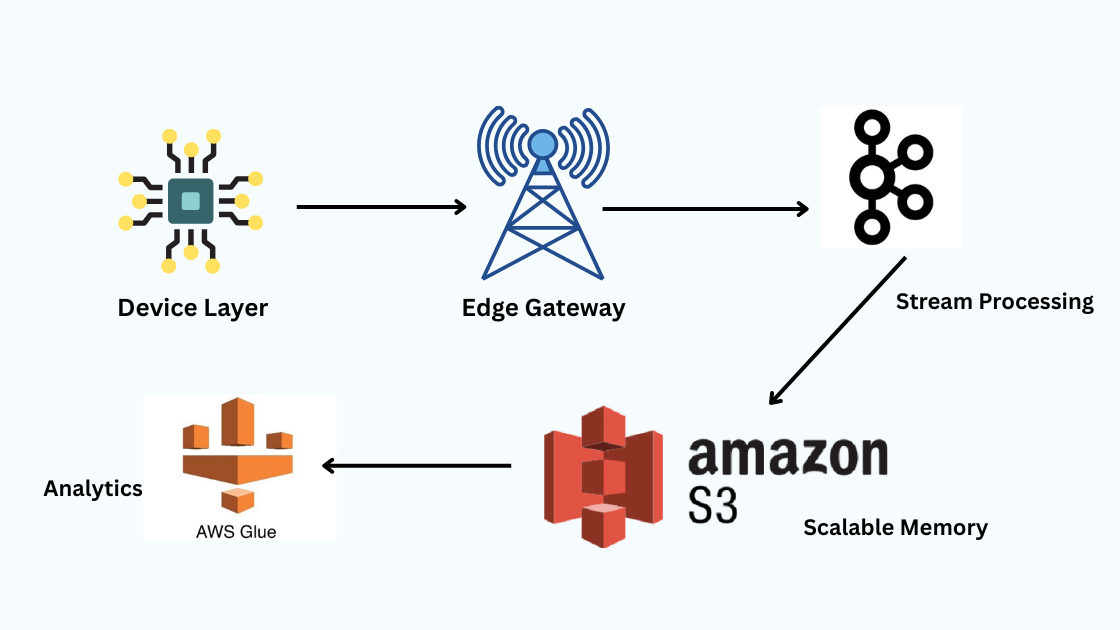
The true power of the Internet of Things does not reside in the sensors themselves. It resides in the pipelines that collect, move, transform, and analyze the continuous streams those sensors produce. A single industrial plant can generate terabytes of telemetry daily. A city-scale deployment of environmental monitors, smart meters, and traffic sensors multiplies that volume further. Without robust data pipelines, this flood of information becomes noise rather than insight. Designing systems capable of handling massive sensor streams—reliably, at low latency, and at acceptable cost—has therefore become one of the central engineering challenges of modern IoT.
An IoT data pipeline is the end-to-end path data travels from physical measurement to actionable intelligence. It typically begins at the sensor or device, moves through gateways and edge nodes, crosses networks via lightweight protocols, enters durable streaming platforms, undergoes real-time or near-real-time processing, lands in specialized storage, and finally feeds analytics, machine learning models, dashboards, and automated control systems. Each stage introduces distinct requirements around throughput, latency, reliability, schema management, security, and cost. Successful pipelines treat these stages as a coherent architecture rather than a collection of disconnected tools.
Collection starts at the edge. Sensors convert physical phenomena—temperature, vibration, pressure, flow, acoustic signatures, images—into digital samples. Firmware and device software must timestamp those samples accurately, attach device identity and quality indicators, and apply initial filtering. Clock synchronization via NTP or similar mechanisms is essential; otherwise downstream time-series analysis becomes unreliable. Many devices also perform simple aggregation or thresholding so that only meaningful changes or statistical summaries are transmitted, dramatically reducing bandwidth consumption. Edge gateways and industrial PCs often take this further by normalizing protocols (OPC UA, Modbus, proprietary fieldbuses), buffering data during connectivity outages, and applying more sophisticated local preprocessing.
Transport protocols then move the data toward processing infrastructure. MQTT remains a dominant choice for constrained devices because of its lightweight publish-subscribe model, quality-of-service options, and low overhead. HTTP, CoAP, and emerging alternatives serve other scenarios. For high-volume or multi-consumer workloads, data frequently lands in a durable streaming platform such as Apache Kafka (or managed equivalents). Kafka’s partitioned, replicated log provides the buffering, replay capability, and fan-out that pure MQTT brokers alone may not scale to handle. The combination—MQTT at the edge feeding Kafka in the core—has become a common and effective pattern.
Once data enters the streaming layer, real-time processing becomes possible. Stream processing engines such as Apache Flink, Kafka Streams, or cloud-native services perform filtering, enrichment, windowed aggregations, joins with contextual metadata, anomaly detection, and feature extraction. Event-time processing with watermarks handles late-arriving data gracefully—an almost inevitable occurrence in distributed IoT environments. Schema registries enforce and evolve data contracts so that producers and consumers remain compatible as device firmware and analytical requirements change. Exactly-once or effectively-once semantics, combined with idempotent consumers, protect against duplicates that can arise from at-least-once delivery guarantees.
Storage strategies must accommodate both the velocity of streaming data and the needs of historical analysis. Time-series databases optimized for high-ingest rates and efficient range queries store recent, high-resolution telemetry. Object storage or data lakehouses hold longer-term raw or lightly processed archives at lower cost. Continuous aggregates and materialized views pre-compute common queries, while tiered storage policies move aging data to colder, cheaper media. The separation of immutable history from rebuildable projections allows pipelines to recover cleanly from processing errors and supports regulatory audit requirements.
Analytics and decision layers sit at the far end of the pipeline. Real-time dashboards surface operational KPIs. Rules engines and stream processors trigger alerts or automated responses. Machine learning models—whether running at the edge for low-latency inference or in the cloud for complex training and scoring—consume curated features. Feedback loops that capture operator confirmations or actual outcomes improve future model accuracy and close the gap between prediction and action. In industrial settings, this end-to-end flow underpins predictive maintenance, quality control, energy optimization, and process automation.
Several architectural patterns have proven effective. A pure cloud-centric design simplifies operations but can suffer from latency, bandwidth costs, and vulnerability to network disruption. An edge-heavy design keeps more intelligence local, improving responsiveness and privacy while reducing cloud spend, yet increases the complexity of managing distributed software and updates. Hybrid architectures—edge preprocessing and filtering, regional stream processing, and centralized long-term analytics—often deliver the best balance. Dual-path designs that route the same data simultaneously into real-time streams and batch archival paths support both immediate action and deep historical analysis.
Challenges remain substantial. Volume and velocity can overwhelm under-provisioned components; backpressure handling and elastic scaling are therefore essential. Heterogeneous devices produce inconsistent schemas, units, and quality levels, making robust validation and enrichment layers critical. Security spans device identity, encrypted transport, access control at every hop, and protection of both data in motion and data at rest. Operational complexity grows with the number of stages and the need for observability—metrics, logs, distributed tracing, and data-quality monitoring must cover the entire path. Cost control requires deliberate decisions about what data to keep at high resolution, what to aggregate, and what to discard.
Best practices that consistently improve outcomes include aggressive edge filtering and aggregation (often reducing transmitted volume by 60–90 percent), explicit handling of event time versus ingest time, schema-first design with registries, clear separation of responsibilities between layers, and comprehensive monitoring of end-to-end latency and data freshness. Starting with a focused pilot—limited sensors, a well-defined use case, and measurable success criteria—allows teams to validate the pipeline before scaling. Treating the pipeline itself as a product, with versioning, testing, and continuous improvement, prevents it from becoming a fragile accumulation of point solutions.
Looking forward, several trends are shaping the next generation of IoT data pipelines. Tighter integration of edge AI enables more sophisticated local decision-making and further reduces the data that must leave the device. Managed streaming and serverless offerings lower the operational burden of platforms such as Kafka. Data lakehouse architectures blur the traditional boundary between streaming and batch, allowing a single storage layer to serve both. Stronger emphasis on data governance, lineage, and quality metrics reflects the growing recognition that downstream AI and analytics are only as reliable as the pipelines that feed them. Regulatory requirements around data residency, retention, and security continue to influence architectural choices.
For readers following the Madros Academy of Technologies series on the Internet of Things, data pipelines form the connective tissue that links earlier topics. Edge AI depends on efficient local processing stages within the pipeline. Industrial IoT deployments succeed or fail based on the reliability of sensor-to-insight flows. Smart home and security considerations intersect with how data is collected, transported, and protected. Mastering the design and operation of these pipelines is therefore essential for anyone seeking to extract sustained value from connected systems.
Massive sensor streams are no longer a future problem; they are the present reality of IoT. Organizations that invest in thoughtful, scalable, and observable data pipelines convert that raw volume into timely decisions, operational resilience, and competitive advantage. Those that treat data movement as an afterthought find themselves drowning in telemetry while starving for insight. The difference lies in architecture, discipline, and a clear understanding that the pipeline—not the individual sensor—is where IoT value is created.
Loved this post?
Browse the catalogue of our Cohort, Elite, VIP and Self-Paced programmes to find one that may suit your needs.
Explore our programmes →Comments (0)
No comments yet. Be the first to leave a comment!
Leave a Comment
Categories
- 5G, Networking & Connectivity
- Artificial Intelligence
- Big Data & Data Engineering
- Blockchain & Web3
- Cloud Computing
- Cybersecurity
- Data Science & Analytics
- DevOps & Site Reliability
- Emerging & Frontier Technologies
- Ethical Hacking & Penetration Testing
- Green Tech & Sustainable Technology
- Internet of Things (IoT)
- Machine Learning
- Madros Events
- Mobile App Development
- Product Design
- Programming Languages & Paradigms
- Quantum Computing
- Software Development
- Tech Startups & Entrepreneurship
- Virtual & Augmented Reality
- Web Developement
Recent Posts
• Something Big Is Coming to MADROS on Dec 12 • IoT Data Pipelines: Collecting, Processing, and Analyzing Massive Sensor Streams • Edge AI in IoT: Running Machine Learning Models Directly on Devices • Smart Home Ecosystems: Interoperability Issues and Future Standards • Industrial IoT (IIoT): Transforming Manufacturing with Sensors and Predictive Analytics • IoT Security Challenges: Protecting Connected Devices from Emerging Threats • Madros Workstation: Building the Digital Workspace for the Modern African ProfessionalReady to Level Up?
Explore our practical, live, and certification tech courses today.
Explore Courses →