The traditional idea of professional development has always followed a relatively simple path: learn something, receive a certificate, apply for a job and begin building a career.
That model is becoming increasingly difficult to sustain.
The modern professional operates in an environment where technologies change rapidly, employers increasingly evaluate demonstrable capabilities alongside formal qualifications, and opportunities can emerge from almost anywhere in the world. A person can learn a valuable skill today and discover six months later that the tools, workflows or expectations surrounding that skill have already changed.
This is particularly significant for Africa.
Across the continent, millions of young people are entering an economy that is becoming increasingly digital, while businesses are simultaneously searching for people who can do more than simply present certificates. The challenge is therefore no longer just about teaching people technology. It is about creating better pathways between learning, capability, professional visibility and economic opportunity.
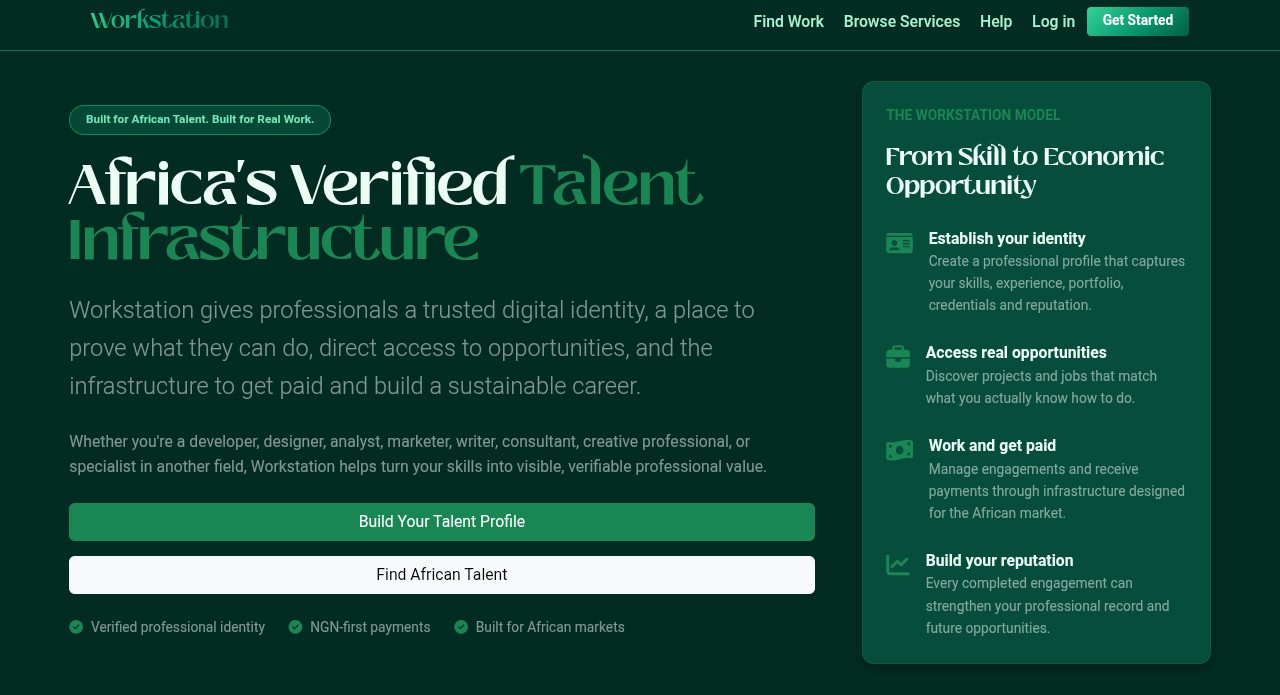
This is the thinking behind Madros Workstation.
Beyond the Certificate
The technology education industry has done a remarkable job of making knowledge more accessible.
Someone with an internet connection can now learn programming, data analysis, artificial intelligence, product design, digital marketing or cybersecurity from institutions and experts anywhere in the world. Platforms such as our Madros Academy, Coursera, edX and countless specialised learning platforms have demonstrated how dramatically education can be expanded through technology.
But access to learning does not automatically produce economic opportunity.
There is a substantial difference between knowing something and being able to demonstrate that you can use that knowledge effectively.
A learner may complete a course in software development but still have no portfolio. A designer may possess strong technical ability but have limited professional visibility. A graduate may have several certificates but lack a structured way to document projects, experience, achievements and progression. An emerging professional may have the right skills but no meaningful connection to communities, mentors, collaborators or opportunities.
The gap between these things is where the next generation of education technology needs to operate.
Madros Workstation is being developed around that gap.
Rather than treating learning as an isolated destination, the idea is to create a digital environment in which learning can become part of a broader professional journey.
The Workspace as the Next Layer of Professional Education
The word workstation is deliberate.
A workstation is not simply a place where information is stored. It is a place where work happens.
That distinction is important.
The next generation of digital education should increasingly move from platforms that simply deliver content toward environments that help people do things.
A modern professional needs somewhere to organise projects, document achievements, build evidence of capability, collaborate, receive feedback, discover opportunities and maintain a professional identity.
The World Economic Forum's Future of Jobs Report has consistently highlighted the pace at which technological change is reshaping skills and employment. Its 2025 analysis similarly points to the growing importance of technological literacy, AI and big data, networks and cybersecurity, alongside human capabilities such as analytical thinking and adaptability.
The implication is straightforward: professional development can no longer be treated as a one-time educational event.
It is becoming a continuous process.
And continuous development requires infrastructure.
From Learning to Evidence
One of the most important changes taking place in professional hiring is the increasing importance of evidence.
A certificate can establish that someone completed a programme. A portfolio can show what they actually built. A project can demonstrate how they approached a problem. A professional record can show progression over time.
These forms of evidence answer questions that a conventional certificate cannot:
- What can this person actually do?
- What have they built?
- What problems have they solved?
- How have their capabilities developed?
- Can someone else verify their work?
These questions become even more important as artificial intelligence makes it easier to generate generic outputs.
In an AI-assisted world, simply producing something is becoming less remarkable. Knowing how to define a problem, make sound decisions, validate an output, collaborate with others and take responsibility for the result becomes increasingly valuable.
That means the professional profile of the future may need to contain much more than a list of qualifications. It may need to become a living record of capability, experience and contribution. This is one of the areas in which a platform such as Workstation can become particularly relevant.
Why This Matters for Africa
Africa's digital opportunity is often discussed in terms of startups, venture capital and technological innovation. Those are important parts of the story, but they are not the whole story.
The continent also needs infrastructure for developing and connecting its human capital.
The World Bank's Digital Economy for Africa initiative has highlighted the importance of digital skills, infrastructure, digital platforms, financial inclusion and digitally enabled services in building inclusive digital economies.
These components are interconnected.
Better connectivity makes digital learning more accessible. Better learning develops skills. Better skills can improve employability and entrepreneurship. Professional networks can connect those capabilities to opportunities. Businesses can then access a broader pool of talent.
The result is an ecosystem rather than a collection of disconnected services.
This is particularly important in countries such as Nigeria, where the size of the population creates both a significant employment challenge and an enormous potential talent base.
Nigeria does not merely need more people who have taken technology courses.
It needs more people who can learn, build, demonstrate, collaborate and participate economically.
A Different Relationship Between Education and Work
The distinction between education and work has traditionally been quite rigid.
- You go to school.
- You graduate.
- You look for a job.
- Then you continue learning when necessary.
Technology is gradually disrupting that sequence.
A software developer may learn a new framework while working on a client project. A digital marketer may acquire an AI capability because a business problem requires it. A designer may learn through a collaboration with another professional. An entrepreneur may simultaneously be a learner, employer, service provider and mentor.
The professional journey is becoming continuous and multidirectional.
This is why the concept behind Workstation extends beyond the traditional LMS.
An LMS answers a fundamentally educational question:
What should this learner learn?
A professional workspace needs to help answer additional questions:
- What can this person do?
- What are they working on?
- What have they accomplished?
- Who can they collaborate with?
- What opportunities are available to them?
- How can their progress be demonstrated?
That is a considerably broader problem.
Where AI Changes the Equation
Artificial intelligence makes this transition even more significant.
The emergence of AI assistants and increasingly capable AI systems means that individuals can now access levels of assistance that previously required teams of people or significant amounts of specialised expertise.
But AI does not eliminate the need for professional infrastructure. In many cases, it makes that infrastructure more important.
If everyone has access to increasingly capable AI tools, differentiation will increasingly depend on how people apply those tools to real problems.
The professional who understands a business problem, frames it correctly, uses AI intelligently, validates the result and turns it into something useful may have an advantage over someone who simply knows how to generate prompts.
This points toward a future in which professional platforms need to support not just knowledge acquisition, but human capability augmented by technology.
That is an important distinction for the future of education.
Building for the Professional, Not Just the Student
Madros Workstation therefore represents a broader question for Madros itself:
- What should happen after someone learns?
- The answer cannot always be another course.
- Sometimes it should be a project.
- Sometimes it should be mentorship.
- Sometimes it should be collaboration.
- Sometimes it should be an opportunity.
- Sometimes it should be a professional record that allows someone to demonstrate what they have accomplished.
- And sometimes it should simply be a place where all of these things can exist together.
This is particularly relevant to the wider Madros ecosystem.
Madros Academy focuses on practical technology and professional education. Madros Lessons provides the underlying training infrastructure through which different forms of learning can be delivered and managed. Workstation extends the journey beyond the classroom toward the professional environment.
The objective is not to create disconnected digital products.
It is to progressively build an ecosystem in which learning can lead somewhere.
The Bigger Opportunity
The most interesting opportunity may not be the technology itself.
It is the possibility of changing how professional development is experienced.
Imagine a young Nigerian entering a technology programme with little more than an interest in the field.
- Over time, that person learns.
- They complete projects.
- They receive feedback.
- They build evidence of their ability.
- They collaborate with other people.
- They develop a professional profile.
- They discover opportunities.
- They continue learning as the industry changes.
Eventually, the distinction between their “learning environment” and their “professional environment” becomes less important.
That is the direction in which digital professional infrastructure is likely to evolve.
And Africa has a particular reason to pay attention.
The continent has a large and growing young population, expanding digital connectivity and an increasingly important technology sector. The question is not simply whether African people will participate in the global digital economy.
The more important question is whether the continent will build enough infrastructure to help its people participate effectively, visibly and sustainably.
Building the Workspace
Madros Workstation is still being built.
That is important to acknowledge.
It is not being presented as a finished answer to every problem surrounding education, employment and professional development. Instead, it is an evolving attempt to solve a problem that is becoming increasingly difficult to ignore.
Learning alone is not enough.
Skills without evidence can remain invisible.
Talent without opportunity can remain underutilised.
Opportunities without capable people can remain unfilled.
And technology without an ecosystem can remain fragmented.
The opportunity lies in connecting these pieces.
For Madros, Workstation is therefore more than another digital platform. It represents an attempt to build the layer between learning and professional participation—a digital workspace where people can develop, demonstrate and advance their capabilities as the nature of work continues to change.
The future of professional education may not belong entirely to classrooms, courses or certificates.
It may belong to ecosystems that help people learn, build, prove, connect and progress.
That is the space Madros Workstation is being built to explore.
Loved this post?
Browse the catalogue of our Cohort, Elite, VIP and Self-Paced programmes to find one that may suit your needs.
Explore our programmes →Comments (0)
No comments yet. Be the first to leave a comment!
Leave a Comment
Categories
- 5G, Networking & Connectivity
- Artificial Intelligence
- Big Data & Data Engineering
- Blockchain & Web3
- Cloud Computing
- Cybersecurity
- Data Science & Analytics
- DevOps & Site Reliability
- Emerging & Frontier Technologies
- Ethical Hacking & Penetration Testing
- Green Tech & Sustainable Technology
- Internet of Things (IoT)
- Machine Learning
- Madros Events
- Mobile App Development
- Product Design
- Programming Languages & Paradigms
- Quantum Computing
- Software Development
- Tech Startups & Entrepreneurship
- Virtual & Augmented Reality
- Web Developement
Recent Posts
• Something Big Is Coming to MADROS on Dec 12 • IoT Data Pipelines: Collecting, Processing, and Analyzing Massive Sensor Streams • Edge AI in IoT: Running Machine Learning Models Directly on Devices • Smart Home Ecosystems: Interoperability Issues and Future Standards • Industrial IoT (IIoT): Transforming Manufacturing with Sensors and Predictive Analytics • IoT Security Challenges: Protecting Connected Devices from Emerging Threats • Madros Workstation: Building the Digital Workspace for the Modern African ProfessionalReady to Level Up?
Explore our practical, live, and certification tech courses today.
Explore Courses →